
musics for heads/punks/other assorted outsiders
Showing posts with label post-punk. Show all posts
Showing posts with label post-punk. Show all posts
Sunday, December 8, 2013

Tuesday, December 3, 2013
Time Will Be Kind: Lorna Donley and DA

[EDIT]: Awful news yesterday that Lorna passed on. The text of this old post hardly articulates how much this band meant to me, how they introduced me to the first wave of Chicago punk, how many nights I've spent blaring these tunes when I feel most isolated and confused, how fellow DA fan Kathryn and I plotted to visit her at the library tell her these things, how crushed I feel that we can no longer do that -- Lorna is a artist whose death that has affected me unlike any I can recall. This is the second-most-viewed post I've done, so I'm glad to have been able to bring the band's attention to some of you over the past couple of years. Anyway I'm bumping the post in her honor.
---------------
Surely my favorite of the original Chicago punk groups right here. Formed in 1978 by a teenage Lorna Donley, Da (alternately known as DA or Da!) was a mainstay of the Chicago scene by 1980, gigging with out-of-town bands like the Fall, Hüsker Dü (in their 'ultracore' period), and DNA. For most of their run they were a majority woman band, their cool post-punk typically (and rather lazily) compared to Siouxsie and the Banshees.
The first record here is their single, Dark Rooms b/w White Castles. A-side has this pernicious spareness to it, where each part of the song drifts in like another intrusive thought. The guitar chimes with echoes of '60s groups like the Byrds, but whatever hope or optimism that generation had is in short supply here. Instead, Lorna's chanting vocals summon dim specters (in a city with many demons) to convene with those living lifeless in the days of Reagan's empire. "White Castles" is a groovy rant on race and class stratification, presumably in Chicago -- but since Dick J. Daley's de facto enforcement of segregation vitally influenced the racist organization of post-war American cities (see the equally subtle and violent, ultimately successful campaign against fair housing, despite the efforts of MLK), the song reaches wider. Seeing how things have gone since 1981, the urban situation is easily desperate enough for this song to hold up today.
You can read a great Coolest Retard article reviewing this record, (plus a review of Strike Under's Immediate Action 12" EP and a Strike Under interview) in the Dementlieu Punk Archive.
You can read a great Coolest Retard article reviewing this record, (plus a review of Strike Under's Immediate Action 12" EP and a Strike Under interview) in the Dementlieu Punk Archive.

Second is Time Will Be Kind, released shortly after the band's end in 1982. It continues in the more driving, gothic postpunk of "White Castles" but with less angularity and more developed songwriting. I won't go over each song -- just play the video of the opening track -- but suffice it to say that the Byrds' dissociative alienation (e.g. "Eight Miles High") is twisted past dazed confusion to tired rage. Nowhere is this more apparent than on "This Doubt," right at the end of the EP where the band rips into what I find to be one of the most cathartic loner jams in punk. And without any sort of HC gimmicks of speed or blunt heaviness. Grasping for evidence of how-it-could-be, finding mostly nothing, but refusing to stand down and accept how-it-is. It pains me that this band left behind so little, but what they did make has a lot of replay value.
These used to be the band's only official recordings, aside from two live songs on the Busted at Oz comp, which you can check out here. But in 2010, Factory 25 Records released a compilation of unreleased recordings, entitled Exclamation Point. I got a copy back then and definitely recommend it.
Buy DA - Exclamation Point
Download Dark Rooms + Time Will Be Kind


Tuesday, August 13, 2013
The Ex - Aural Guerrilla [1988]

theex.nl
everything is falling into place
Wednesday, June 26, 2013
NORA & the JANITORS


Enter Nora & the Janitors, slamming their head against a brick wall of willful ignorance in the most listenable
way possible. These two tunes bounce along somewhat like Orange
Juice, but instead of said band's carefree joviality, this reeks of the bitter resignation I associate with '80s Siberian
punks like GrOb or Yanka. It can't be easy to work such desperate
howling -- with lines like "fell asleep, it was July // woke up, it was November // did I kill that cop? I can't
remember" -- into synthed-out, guitar-driven pop songs and
have it come off as well as it does. I dunno, people will probably
compare this to the Smiths, but I get the feeling that's not where Nora et al are coming from. Whatever it
is, I've had "Banister" on repeat for weeks now, and have yet to tire of it.
Maybe my favorite song of 2013 so far. I shouldn't even be devoting
this much text to a two-song single. But this stuff really affected
me, and it deserves a wider audience.
These two songs are coming out on a tape split with a Minneapolis band I can't find any information on. For now, get this single at N&tJ's bandcamp.
These two songs are coming out on a tape split with a Minneapolis band I can't find any information on. For now, get this single at N&tJ's bandcamp.
Wednesday, March 27, 2013
re-up'd: Sonic Youth - Hold That Tiger [1987]

Quick, here's a Sonic Youth boot some of you maybe don't have. Recorded at the Metro in Chicago on October 14, 1987. Thanks to quality mic-placement, this is some real clanging, articulately shredded-up EVOL and Sister material from what is maybe my favorite period of this band. People forget Sonic Youth was a punk band, and this gig demonstrates it. The version of 'Death Valley '69' rages so hard that you forget it's missing Lydia Lunch's vocal part. Following a soaring version of 'Pacific Coast Highway' is a Ramones coverset encore.
The Japanese text on the cover inexplicably reads 'my mother went shopping.' Perhaps the band was studying up for their semi-upcoming 1988 tour of Japan.

SY concert archive entry for this gig
"I have no desire to fuck Jessica Hahn but I would like to kill Jim Bakker"
re-up'd: Hüsker Dü - Metal Circus [1983]

As you probably know, I get the name of this site from the most famous album by St. Paul, Minnesota's Hüsker Dü, as they are one of my favorite bands of ever. Zen Arcade was part of a paradigm shift in punk and hardcore, as the Hüskers, alongside Black Flag, the Minutemen, Sonic Youth, other SST bands, and countless others the world over were permanently expanding the creative capacity of counter-culture music.
Ten months before Zen Arcade was released, they put out the Metal Circus EP. It is the pivot around which the band changed its direction, from the 'ultracore' of their earlier singles and albums toward the stuff that got them remembered (and ultimately destroyed by a major label). You can read a 1982 interview with the band in the second issue of the D.C. zine Thrillseeker -- their answers are very foretelling.
As for the songs, this is when Hüsker Dü really hit their stride. The 'Minnesota guitar snowstorm' sound is fully operational, and the record is filled with soaring harmonics that let melody sneak into unexpected places. 'Real World' is a folk tune for the disillusioned rebel ("you're not a cop or politician, you're a person too -- you can sing any song you want, but you're still the same"), but it somehow sounds hopeful rather than cynical. The next two are some great Reagan-punk sort of songs about coping with impending nuclear apocalypse. The first side finishes with the boozer's lament "First of the Last Calls," borne from guitarist Bob Mould's own troubles with drink.
The the second side could be read as the thematic conclusion of the problems brought about in the first. After the brief whirlwind of "Lifeline," in which Bob screams about falling into the abyss, the abyss is reached. "Diane" starts. Greg Norton's bass churns out ominous chords, and Grant Hart drums along as he sings the true story of a woman raped and killed in Minnesota, from the p.o.v. of the perpetrator. It's a haunting electric murder ballad, a apt climax to the five songs that preceded it. The record ends with "Out on a Limb," a Sabbath-y dance of precarity. Listening to the words or reading along to this EP, there's a sense of narrative progression. Once they were able to show themselves capable of doing a concept record, they went all the way with it and ended up with the 'concept double album' that followed it in '84.
In my upload I included four outtakes from the Metal Circus sessions, which are of variable fidelity. However, they are some fierce punk tunes. Hüsker Dü are one of the few bands whose rejects are practically as good as the stuff they commit to wax. One of these, "Standing By the Sea," would be attempted again on Zen Arcade.
Finally, if you're still reading along with this, you're probably a big fan of the Hüskers yourself. So you might appreciate this graphic about the cover art, if you haven't seen it already.
 |
| graphic belongs to Patrick Smith |
The inscription on the A-side reads, "That old stainless charity. If you could see me now, Shirley." On the B-side it's "Falling from grace with the goose; Howard Hughs, a wing, a prayer, (see below)."
Buy Metal Circus on insound
Discogs vinyl link
I like to protest but I'm not sure what it's for
re-up'd: End Result - Ward EP [1985]

Chicago punk in the '80s had its fair share of weirdos, but End Result in particular pushed the envelope of what people would tolerate hearing. Not quite as blatantly crass as, say, the Mentally Ill, but musically these Southside punks could really test your patience. Don't let the more-or-less straightforward opening track deceive you; the Ward EP quickly devolves into an unrighteous mess of horns, semi-competent guitar squall, and psychotically howled vocals. The bizarre rendition of Petula Clark's 'Don't Fall Asleep in the Subway' must be heard to be (dis)believed.
 |
| from Maximumrocknroll #3 |
From Roctober:
Chicago's End Result was a multi racial experimental No Wave band born out of the early 80s hardcore scene. They managed to limp all the way to the end of the 80s with a rotating cast (at one point they advertised they were seeking a "singer with a hatred of music") built around guitarist [Alan] Jones. Perhaps their greatest legacy is that they paved the way for No Wave/artfuck bands presenting themselves to an all-ages, hardcore/punk audience, something that defined the Chicago underground of the 90s (Milk of Burgundy, Skingraft, etc.). Their odd songs (a straightforward tune about amputation wasn't atypical) were released on Articles Of Faith's Wasteland label, and on several important Midwestern hardcore/punk comps, resulting in fans of boundary-pushing gravitating towards them, including Steve Albini and Sonic Youth. No child of privilege, Jones lived in a mission for a while, and turned lemons into an odd tasting lemonade by briefly making the mission's basement a site for punk shows.
End Result fit into the Chicago punk puzzle somewhere between early Silver Abuse and ONO. Here's a video of them circa 1984:
I know it was my fault, but I'm gonna take it out on you
re-up'd: Big Black - Sound of Impact [1986]
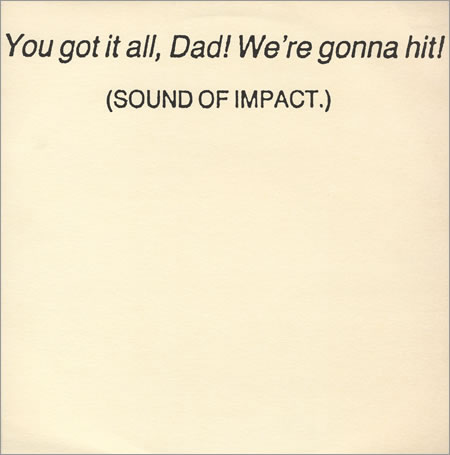
This is probably thee best recording of Big Black, and just goes to show what an unstoppable force they were as a live act. It was recorded in 1986 In Minneapolis, Clogland (Netherlands?), and Muncie, Indiana. There is a wealth of information available about this official 'fake bootleg' from the badass site Les Dementlieu Punk Bibliotheque, with this synopsis:
Compiled from four or five different soundboard recordings, this LP is a quality productTM, despite appearances to the contrary. It also comes with a nifty booklet of photos and misc. crap to keep you amused when you aren't listening to the record.
This was also supposedly the cause of Big Black's break with Blast First. The idea for its release was conceived during their first visit to Europe in early 1986 (when they were being wooed by Blast First), and appeared in October or November of that year. The album was supposed to be released like a scummy bootleg--no contact info, no band name on the record, a fake record label (Walls Have Ears), in a numbered edition of 1000 copies. When that 1000 copies sold out, 500 more numbered copies were pressed with the band's permission. Then in 1990 (I think) an unnumbered and unauthorized edition of 500 was pressed, and when they started turning up in US record stores Albini threw a shitfit, and even claimed he was going to burn the $5000 Paul Smith had offered him as payment for the unauthorized repress. I don't know if Steve actually did burn the money, but he sure left Blast First in a huff, taking Big Black, Rapeman and Arsenal with him, as well as scuttling the planned Last Live video and album.
In addition, the back cover is covered in black box transcripts from planes that crashed. You can read them all at the above linked site.
The songs on this record are definitive versions; they are in just about every case superior to the studio versions. The titles are all changed, 'bootleg-style,' but if like Big Black you'll probably recognize them all. The version of 'Jordan, Minnesota,' here given as 'Toytown Daddy Oh!' is legitimately terrifying and disgusting. There's lots of good Albini stage banter and storytelling throughout, so you know you want to listen to this. Easily my favorite thing by Big Black.
Has anybody heard of the Yanomamo Indians?
re-up'd: Algebra Suicide - Real Numbers [1988]
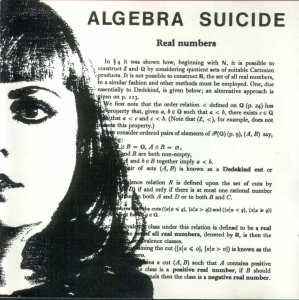
Algebra Suicide were a post-punk duo from Chicago, active from 1983-1993. They ended up on a few international compilations in the '80s, and even made it out to Europe for a tour in 1990. This CD is two long tracks, each a live set recorded at Links Hall in 1988. It is really good. Lydia Tomkiw recites off-the-wall, strangely familiar poetry while Don Hedeker conjures ethereal accompanying textures on the guitar and administers the drum machine. Here he is saying a few words about this particular recording and performance; I'll defer to him since he says it best. Lydia left this world in 2007 after a long bout of alcoholism and declining health. You can read touching tribute to her written by Sharon Mesmer here.
This is a fantastic, mostly forgotten bit of Chicago music history. Don't put it off because of the long track lengths. See, I've given you the set list right here, so no complaining:

"Here, the only things being tortured are the lawns"
Plastic Crimewave writes about Algebra Suicide
Wednesday, January 23, 2013
Harshist - Mythologies CS [2012]

This here is one of my favorite tapes of 2012, hands down. Truly I have waited too long to post it. Ten minutes of psych-punk tunes that reek of societal anguish. The music carries vibes shared by post-punk types like Shoppers or the Pop Group. I hear the latter band's influence especially on the last song, "Poison God," which opens up with a chord straight outta "She Is Beyond Good and Evil." Seriously can't recommend this band enough, and if they're any indication, there's some radical stuff happening Hawaii these days. Peep a couple of the songs in this live video from last summer:
Go to their bandcamp to listen to/buy Mythologies as well as an excellent radio set just released this month. Once you've heard the tape you'll need to hear the full set; the stretched-out noise passages really complement the groovy punk stuff. Do not sleep on this.

http://harshist.tumblr.com
http://diyhawaii.tumblr.com
Tuesday, January 22, 2013
Bernays Propaganda - Igraj Slobodno! [2012]

Bernays Propaganda are a band from Skopje, Macedonia. Since 2007 they've been creating post-punk music you can -- gods forbid -- dance to, with words you can -- if you know Macedonian -- raise a fist and get pist with. Any band that names itself after the dude who applied psychoanalysis to marketing in order to transform propaganda into the public relations industry is going to have a fairly up-set view of politics; but few things are as aggravating as a political band whose lyrics don't go beyond lazy sloganeering. Thankfully these folks write more from a perspective of personal struggle in the context of social and political relations, and are much better off for it. Musically, they are punk rock for the Club, weird as it feels to say; they lie somewhere among LCD Soundsystem, early Liars, or Soviet rockers like Kino.
Igraj Slobodno! is an album of remixes, collaborations, and covers of Bernays Propaganda songs from their previous two full-lengths. The people sitting in on this are as varied as they are esteemed. My favorite track is the version of "I Care Not to Know" by cult breakpop act ZEA (aka Arnold de Boer, lately also singer of the Ex): a glitchy, acoustic skeleton of the original which underpins the paranoid vocal. Other highlights are the two versions of "Buldozer" by Gang of Four's Mark Heaney and "the oldest active Macedonian jazz band," Sethstat. Each take the tune to very different places: the former makes it into something you might hear at a rave, the latter a stomping jazz number with cool vibraphones and a brass section. Overall a real great set if you aren't instantly averse to dance floor stuff.
This one is available from bandcamp for free, as hinted by the translation of the album title: play freely! Check out the original versions of the songs on the other two albums up there, as well as a song from their forthcoming third full-length, Zabraneta planeta.
Sunday, December 9, 2012
NEGATION - Demo [2012]

Here's a demo tape fresh outta New Orleans. Pretty rough around the edges but I definitely hear something good coming out of these folks' amps. Negation have a driving post-punk sound in the vein of the better purveyors of no-wave, with feet planted firmly in the realms of both the cerebral and the untamed. But this ain't some No New York ripoff band; a closer point of reference might be Silver Abuse, and the scuzz guitar reminds me of End Result more than a little bit (of course, most everything sounds like 80's Chicago punk or Hüsker Dü to me, so what do I know). The three members all share vocal duties, which is always a plus in my book when done well.
I will say this demo sounds pretty great paired with the Orbit/Regrets 7" by Kitchen's Floor. They don't really sound the same, and the association is probably arbitrary on my part, but their respective rackets complement each other in my ears.

I don't want to draw too many conclusions from such an early document of a band, but suffice it to say I'm excited to see what happens with this three-piece. A couple months ago I ran into the bass player Osa when the POC Zine Project Tour stopped in Urbana. She's much of the brains behind Shotgun Seamstress, a "black punk fanzine that also focuses on black queer & feminist artists and musicians." If that zine is any indication, there are some great ideas to be played with here, so keep an ear out.
You can download the demo for free-ninety-nine at Negation's bandcamp page.
Follow them on tumblr for photos, live dates, etc.
Friday, December 7, 2012
Dog Faced Hermans - Hum of Life [1993]

Sometimes I'm shooting the shit about music with someone or having some other idle conversation, and one of us will mention Dog Faced Hermans. Inevitably we'll both crack a grin of having the shared knowledge of the band. Because they're criminally overlooked among your Sonic Youths and Chumbawumbas of the late '80s/early '90s. Their sound really cannot and should not be aped -- much in the same way that Can made music that was singularly Can, the Hermans' music was a convergence of four personalities whose expression at all times openly defied the restrictions of a 'style' that might be copied or clotted into some fad subgenre. Musical and philosophical connections with the Ex are readily discernable, as Andy Moor was playing with these guys in Scotland for years before he joined up with those Hollanders, and the two bands frequently collaborated and toured together.
"How We Connect" is a perfect example of what makes the Hermans so great. Stomping, bassy drums, excavator-engine bass, aggressive horns, and guitar that scuffles and screes on a no-wave frequency, only to stop on a dime and change to something resembling West African highlife. And then there's Marion's vocals. She never really yells so much as sings fiercely, with a poetic clarity that demands your attention and thought. Definitely a good LP band, because these folks know how to exercise song dynamics (for all the experimentation the Hermans engaged in, they wrote good songs, first and foremost). They close this album with Ornette Coleman's "Peace Warrior," a rollicking punch in the gut of a cover that fuses free improv jazz with punk in the most brilliant and intuitive way.
Hum of Life has been out of print for a long time, but in 2009 the vinyl was reissued on Mississippi Records, a very cool-sounding establishment in Portland. I don't know if it's still available, and the store/label's web presence is rather scant, but see if you can get in touch with them to find out: their facebook page has their contact info. For those of you who aren't registered on that NSA shadow site, there's always the old-fashioned physical location/phone number:
Mississippi Records
4007 N Mississippi Ave
Portland, Oregon 97227
(503) 282-2990
Mystery lies in the space between us, I make sound which approaches language
Tuesday, November 20, 2012
ONO - Albino [2012]

Since I mentioned these guys in my End Result post, I figured I should bring it to your attention that ONO released a new record on Halloween. It is a hell of a thing. But before I get into the record perhaps some introduction is in order:
Around 1979 or 1980 the two founding members of ONO, P. Michael and travis, started playing dirty R&B tunes at strip clubs, weddings, wherever else would have them. They were as likely to play stuff by King Crimson as Rufus Thomas or Bo Diddley. Eventually they found their way into the punk scene via queer bars like La Mere Vipere, O'Banions, and Medusa's (travis had been on shore leave from the Navy in time to be around for the Stonewall riots in NYC), freaking out the audiences at shows they played with Chicago bands like Naked Raygun, the Effigies, Algebra Suicide, and of course End Result. Actually their first gig in late 1980 was opening for Special Affect, which featured a pre-Ministry Al Jourgensen. Whenever out-of-towners like Lydia Lunch or Cabaret Voltaire would roll through, ONO would bring the noise.
During that first decade ONO released two LPs, 1983's Machines That Kill People and 1986's Ennui. Two slabs of true weirdness ... people were not particularly receptive to the industrial-noise-gospel-synth dirges contained on those albums, especially when confronted with the band members' outlandish stage attire and unsettling ritualistic behavior in live shows. Still, the band continued to perform through to 1990, appearing on compilations alongside Algebra Suicide, Portland weirdos Smegma, and a whole rabble of forgotten groups. For more info on the band's history, consult the writeup/interview in Roctober, always an authoritative source for Chicago punk and outsider musics.
There wasn't much noise from the ONO camp through the '90s, though travis and P. Michael kept themselves busy with other projects. Then, in the late aughts the world seemed to catch up to them, and ONO started gigging again at various DIY venues throughout Chicago. Which brings us to Albino: a haunting summation of the dark magic the group have generated over the past three decades. I could tell you about "I Been Changed," with its gospel-tune lyrics of redemption sung over a Birthday Party-style blues-punk din, or the excellent cover of the VU's "All Tomorrow's Parties," but really my words can't do this album justice. Just hit play:
Albino is out now on Moniker Records in a pressing of 300. You can stream the album and purchase it on the label's bandcamp page.
Friday, November 16, 2012
Mark Stewart interview in The Wire magazine

So I've been pretty distracted from writing about musics, what with heavy classes and falafel-slangin' taking up most of my time. But I'll have a few days free to get back into things on this page, so look forward to some new submissions and classic hits.
In the meantime, check out this lengthy interview in The Wire with Pop Group vagabond Mark Stewart. Dude is all over the place -- quite literally in terms of geography, as well as music and ideas.
Monday, August 6, 2012
Lark's Tongue - 3 Songs [2011]

Lark's Tongue are another great Peoria band, and I've been banging my head to their EP's stadium-sized heavy guitar jams for a while now. I'm sure the actual stadiums they play in are more basement-sized, which can only mean that seeing these guys live would be an event to pummel the eardrums. However, the best part of this EP might be the vocal harmonies, which come down on high to lift you out of the guitar cloud. Somebody in this band must dig old Smashing Pumpkins albums, and the results are good.

Lark's Tongue seem to keep busy enough, playing in and around Peoria, throughout central Illinois, Chicago, Milwaukee, and as far as Denver. This demo EP came out at the start of 2011, but Lark's Tongue has a few vinyl releases planned, a 7" due out August 15 which will be available at their Brass Rail gig with Planes Mistaken for Stars, the Forecast, and Angry Gods, for those of you within driving distance of Peoria. September will bring a split 12" with fellow Peorians Men of Fortune. And if that wasn't enough, Cavity Records will be releasing a split 10" with Across Tundras from Nashville later in the fall. Pay attention, these dudes have plenty for you coming up.

Lark's Tongue/Bird Dialect label site
Sophisticated and tongue-tied
Wednesday, July 4, 2012
Sonic Death - Gothic Session EP [2012]

For those of you who dug the recent Wavepool Abortion post, here's some more '60s-indebted fucked-up rock and roll from a Russian two-piece. Compared to that band, though, Sonic Death have a darker, more folkish sound. Perhaps you could say Sonic Death are the Stooges (I'm thinking 'Gimme Danger') to Wavepool Abortion's Beatles -- or perhaps neither of those bands resemble these. In any case, the vocal harmonies and acoustic chord changes make some great tunes with that world-weary resignation that Russian bands are so good at communicating. The Gothic Session EP came out five months ago, and has been pretty frequent in my rotation since I heard it around that time.
According to the fellows at Aphonia Recordings, this is what the band had to say about making this record:
After a little break we started work on a new session. Seven fresh songs were recorded on a Tascam cassette Portastudio, sitting in the already known bathroom. At this time we used a clean slightly reverbed guitar sound, the drum section was shaded with maracas. The sound is soft, psychedelic vibrating, like The Cannanes meet Vivian Girls on The Seeds cover party. The lyrics are all about dark love emotions and solitude. All of this has been called GOTHIC SESSION. The first track with the western spirit and refrain “I take off all of me/ You will not get pleasure” is entitled ‘Pleasure’ and is like a roll call with Stones ‘Satisfaction’. The second called ‘Now (Son Of A Bitch)’ and has at the end the converted quotation from Misfits “I am goddamn son of a bitch/ you better think about it baby”. Third song named ‘Marzipan’, and has a sample from an amateur slap porn video, whose plot is about pining for the attention from a girlfriend. The fourth acoustic-postpunk song ‘Streets’ laments the loneliness in the city. Fifth ‘To Me’ is classic garage-y amateur guitar rock. The sixth track ‘Huuuh-uuh-uuuh’ is an acoustic ballad for two voices. The last one ‘Floor’ is a confluence of The Jesus and the Mary Chain with Buddy Holly and back again. On the cover, we photographed against a background of the crucifix as Bible sellers in East European chic.
Gothic Session is available at Sonic Death's bandcamp for a mere $5 of your mortal money. They also have a self-titled release for $0, and while they're both good, Gothic Session is the better set.
Wednesday, May 9, 2012
Big Black - Last Show [1987]
I'm knee deep in exams so here's a quick post. Big Black's final performance (disregarding that Touch & Go 'reunion gig'). Playing in a steam plant -- sounds about right for a band people seem to like branding as 'industrial rock.' I haven't watched through this yet so I haven't got anything to say about it, except that apparently Kurt Kobain is in the audience somewhere. Enjoy.
p.s. if you've submitted stuff, I'm working on it.
Tuesday, May 1, 2012
The Ex - 1936, The Spanish Revolution 2x7" [1986]

Happy May Day, comrade. It's a holiday
that is widely uncelebrated in my country, even though it is meant to
commemorate the Haymarket
Massacre, which of course happened in my
hometown. According to Wikipedia,
the US government instead assigned May 1 such comical/Orwellian names
as 'Americanization Day,' 'Loyalty Day,' and 'Law Day.' In any case, if you've got the day off
or are working an 8-hour day (rather than a 14-hour day, or at least
getting overtime pay), you've got unions, socialists, and anarchists
of past generations to thank for it.
For today's post I give you the Ex's
1936, the Spanish Revolution double 7". Those who know the Ex
can probably already attest to the beauty of this release, but I'll
get to that in a minute. First I want to talk about the revolution
itself. It was a pretty special thing; it's not every day that
ordinary people come together to create a relatively well-implemented
anarchist economy and society. If you just want to take free music
without learning anything cool, or if you're a Spanish Revolution
historian, jump to the bottom. The overview is a little lengthy.
The context in which the revolution
took place would be a pretty good place to start. Up to the 1930s,
Spain was a largely preindustrial country controlled by wealthy
landowners, the Catholic Church, and a series of monarchs and
military dictators. Meanwhile, revolutionary fervor was brewing.
Through the turn of the 20th century anarcho-syndicalism
grew popular in rural Spain, and to a lesser extent in cities as
well. The industrial sector was particularly rife with labor
conflict. Strikes were a regular occurrence, and were often violently
broken. Many thousands of workers were jailed or killed in numerous
strike-busting clashes with bosses, police, and the military. In
1910, the CNT (Confederación
Nacional del Trabajo), Spain's national
anarchist labor union, came forth from a series of similar previous
organizations. The militantly revolutionary FAI (Federación
Anarquista Ibérica) was formed in 1927,
following an exasperating decade of postwar economic turmoil that
would be exacerbated by the coming worldwide Depression.
In 1931, the Second Spanish Republic
came to power, consisting of a "largely self-appointed group of
leaders of several small parties that had been formed within the past
two or three years."1 The most pronounced change was the
rise of anticlerical hostility, as the new government began to
dismantle the Church's political authority. Though socialists were
initially well-represented in the coalition government, things had
swung to the right by 1934 with the rise of the monarchist pro-Catholic
CEDA
party, and many of the initial reforms were undone. This was
contemporaneous with the rise of the Nazi Party in Germany, the
Dollfuss regime in Austria2 and on the tails of
substantial rightward shifts in Italy and the USSR. Socialist and
anarchist miners in the northern Asturias region staged a
rebellion/general
strike that was viciously crushed by military
forces led by General Francisco Franco. The shelling decimated the
capital city of Oviedo. The rebellion was followed by intensified
repression consisting of political executions, mass jailings (on the
order of 30,000-40,000)3, wage cuts, and counter-reform.
Franco led the Army
of Africa in a coup against the Second Republic
on July 17, 1936, marking the official start of the Spanish Civil
War. It was in this period of wartime instability that the anarchist
revolution materialized. In the days following the coup, the CNT
mobilized the workforce to take control of the factories, foundries,
and transportation infrastructure, as well as organizing militias.
Noam Chomsky summarizes (better than I can) the revolution in his
1968 essay "Objectivity and Liberal Scholarship":
During the months following the Franco insurrection in July 1936, a social revolution of unprecedented scope took place throughout much of Spain. It had no "revolutionary vanguard" and appears to have been largely spontaneous, involving masses of urban and rural laborers in a radical transformation of social and economic conditions that persisted, with remarkable success, until it was crushed by force […]The left-wing socialist leader Largo Caballero had demanded in June that the workers be armed, but was refused by Azaña. When the coup came, the Republican government was paralyzed. Workers armed themselves in Madrid and Barcelona, robbing government armories and even ships in the harbor, and put down the insurrection while the government vacillated, torn between the twin dangers of submitting to Franco and arming the working classes. In large areas of Spain, effective authority passed into the hands of the anarchist and socialist workers who had played a substantial, generally dominant role in putting down the insurrection.The next few months have frequently been described as a period of "dual power." In Barcelona, industry and commerce were largely collectivized, and a wave of collectivization spread through rural areas, as well as towns and villages, in Aragon, Castile, and the Levante, and to a lesser but still significant extent in many parts of Catalonia, Asturias, Es tremadura, and Andalusia […] The revolution was "apolitical," in the sense that its organs of power and administration remained separate from the central Republican government and, even after several anarchist leaders entered the government in the autumn of 1936, continued to function fairly independently until the revolution was finally crushed between the fascist and Communist-led Republican forces. The success of collectivization of industry and commerce in Barcelona impressed even highly unsympathetic observers such as Franz Borkenau. The scale of rural collectivization is indicated by these data from anarchist sources: in Aragon, 450 collectives with 500,000 members; in the Levante, 900 collectives accounting for about half the agricultural production and 70 percent of marketing in this, the richest agricultural region of Spain; in Castile, 300 collectives with about 100,000 members. […]The period of July through September may be characterized as one of spontaneous, widespread, but unconsummated social revolution. A number of anarchist leaders joined the government; the reason, as stated by Federica Montseny on January 3, 1937, was this: ". . . . . the anarchists have entered the government to prevent the Revolution from deviating and in order to carry it further beyond the war, and also to oppose any dictatorial tendency, from wherever it might come." The central government fell increasingly under Communist control -- in Catalonia, under the control of the Communist-dominated PSUC (Partit Socialista Unificat de Catalunya) -- largely as a result of the valuable Russian military assistance. Communist success was greatest in the rich farming areas of the Levante (the government moved to Valencia, capital of one of the provinces), where prosperous farm owners flocked to the Peasant Federation that the party had organized to protect the wealthy farmers; this federation "served as a powerful instrument in checking the rural collectivization promoted by the agricultural workers of the province." Elsewhere as well, counterrevolutionary successes reflected increasing Communist dominance of the Republic.The first phase of the counterrevolution was the legalization and regulation of those accomplishments of the revolution that appeared irreversible. A decree of October 7 by the Communist minister of agriculture, Vicente Uribe, legalized certain expropriations -- namely, of lands belonging to participants in the Franco revolt […] The decree compelled tenants to continue paying rent unless the landowners had supported Franco, and by guaranteeing former landholdings, it prevented distribution of land to the village poor […]The second stage of the counterrevolution, from October 1936 through May 1937, involved the destruction of the local committees, the replacement of the militia by a conventional army, and the reestablishment of the prerevolutionary social and economic system, wherever this was possible. Finally in May 1937 came a direct attack on the working class in Barcelona (the May Days). Following the success of this attack, the process of liquidation of the revolution was completed. The collectivization decree of October 24 was rescinded and industries were "freed" from workers' control. Communist-led armies swept through Aragon, destroying many collectives and dismantling their organizations and, generally, bringing the area under the control of the central government. Throughout the Republican-held territories, the government, now under Communist domination, acted in accordance with the plan announced in Pravda on December 17, 1936: "So far as Catalonia is concerned, the cleaning up of Trotzkyist and Anarcho-Syndicalist elements there has already begun, and it will be carried out there with the same energy as in the U.S.S.R." -- and, we may add, in much the same manner.In brief, the period from the summer of 1936 to 1937 was one of revolution and counter-revolution: the revolution was largely spontaneous with mass participation of anarchist and socialist industrial and agricultural workers; the counterrevolution was under Communist direction, the Communist party increasingly coming to represent the right wing of the Republic.4[end Chomsky]
After the
Communist-controlled, USSR-funded Republic government had effectively
suppressed and disarmed the anarchists and socialists, who had
constituted a significant proportion of the initial defenders against
Franco's rebels, it proceeded to lose the war against Franco, who
would go on to rule the Spanish State as a authoritarian dictatorship
until his death in 1975, at the ripe old age of 82.
The sad stuff is not what I really want
to emphasize, however. What is important about this piece of history
is the social revolution that took place: a wide-reaching
transformation of society to anarchist organization. The revolution
can be broadly divided into two main parts: collectivization of
industry and collectivization of agriculture.

Industrial collectivization began
within hours of the Fascist uprising. Workers in Catalonia "seized
control of 3000 enterprises. This included all public transportation
services, shipping, electric and power companies, gas and water
works, engineering and automobile assembly plants, mines, cement
works, textile mills and paper factories, electrical and chemical
concerns, glass bottle factories and perfumeries, food processing
plants and breweries."5
Major changes in the organization of the tramways dramatically
increased service while lowering fares. Similarly, anarchist
organization of the vacated medical system (which had been run by
priests and nuns prior to the revolution) introduced socialized
medicine to thousands of Catalonians who had never before had access
to a doctor in their lives. Wages were mostly equalized across
industries, "and ex-bosses given the option of leaving or working as
one of the regular workers, which they often accepted."6
The revolution also
saw the introduction of many women to the workforce, though they
still had to contend with domestic work and were paid less than men.
In any case, industrial collectivization demonstrated the capacity of
the workers to run their own factories without falling into the "chaos" typically attributed to anarchist organization.
Agricultural collectivization was even
more extensive than the collectivization of industry, largely because
most of Spain's workers were still farmers. While the
collectivization was viewed as dangerous and harmful by small- and
medium-level farmers (and, obviously, the owners of large
landholdings), the majority of landless peasants welcomed the change.
Historian Burnett Bolloten describes the process of rural
collectivization:
A CNT-FAI committee was set up in each locality where the new regime was instituted. This committee not only exercised legislative and executive powers, but also administered justice. One of its first acts was to abolish private trade and to collectivize the soil of the rich, and often that of the poor, as well as farm buildings, machinery, livestock, and transport. Except in rare cases, barbers, bakers, carpenters, sandalmakers, doctors, dentists, teachers, blacksmiths, and tailors also came under the collective system. Stocks of food and clothing and other necessities were concentrated in a communal depot under the control of the committee, and the church, if not rendered useless by fire, was converted into a storehouse, dining hall, cafe, workshop, school, garage, or barracks.7
Wages (which often took the form of
coupons rather than money) were based on the size of the family and
the amounts of food and supplies they needed. Resources that were
locally abundant were distributed freely or traded with neighboring
collectives. Although there were reported instances of forced
collectivization, this was not the norm. Small landowners who opted
not to join the collectives were given enough land to support
themselves but were not allowed to hire laborers, and were denied the
social/economic benefits given to members. Large numbers of small
farmers were thus compelled to join the collectives based on economic
pragmatism rather than threat of violence.8 The Chomsky essay quoted above cites reports that production increased in
many of the rural collectives.

Neither the industrial nor agricultural
collectivization was perfect – in fact, there were a number of
problems (see the Siedman book linked below). But imperfection has
hardly stopped us from accepting massively worse systems, such as the
one that is in place now. I am fascinated by the positive aspects of
the Spanish revolution, and it gives me hope that similar experiments
might be possible today (probably in developing countries, which
serve as the best approximations for 1930s Spain).
Which brings me to the records
themselves. In 1986, the Ex recorded four songs to commemorate the
50th anniversary of the revolution. Two songs are sung in
English, and two are in Spanish. They are versions (or syntheses) of
folk tunes sung by CNT-FAI partisans and those who aligned with them.
Some of the words date back to earlier struggles, such as the defense
against Napoleon's 1808 invasion. The Ex's arrangements of the songs
fit snugly into the infinitely mutable realm of 'Ex-music,' and these
are in fact some of my favorite Ex songs. The original release housed
the two 7'' discs in the front and back covers of a 144-page book
compiling scores of CNT archival photos from the period of 1936-1939.
It is a labor of love, as Begemot over at La
Folie du Jour elaborates:
The Ex does not pretend to have accomplished a historical or scientific task, and they make this clear soon enough. They also deny any claim of objectivity: "…Thus [the foto collection] it is a compilation: neither chronological nor objective, but one-sided, partial and subjective. Only from the anarchist’s side…" Instead, they point out their aim, which has a double character: firstly, to show "…how much pleasure, imagination, devotion and energy the Spanish anarchists put in their effort to destroy once and for all the damned class of boots, ties and crucifixes…", the fact that this attempt to revolution "…saw an explosion of creativity which only takes place when you're finally able to conceive of something and follow through on it –to arrange your own life without hate and greed, without competition and oppression…" and finally how this effort "…was immediately [attacked], terrorized and destroyed by the state and the bourgeoisie…" Secondly, their aim is targeting to diagnose the similarities between the Spanish experiment and the present: "…For us the Spanish revolution is not just an event or incident, not just a chapter in a history book. It’s an attempt similar to what we are doing now: trying to get rid of this imposed shit system…" With that, the conclusion comes by the Ex as an afterword: for them, the anarchist experiment of the 30’s shows that "…it certainly is possible to bring an anarchist society into practice…''.

Buy the Spanish Revolution 2x 3" CD + book direct from the Ex
For no one is a slave
Links of interest:
George Orwell – Homage to Catalonia (full text)
Michael Siedman – Workers Against Work (full text) (summary/review)
References
1. Stanley G. Payne. A History of
Spain and Portugal, Vol. 2. "Chapter 25: The Second Spanish Republic." 1973 Madison: University
of Wisconsin Press. p. 630.
2.
Ibid, p. 635.
3. Gabriel Jackson. The Spanish Republic and the Civil War,
1931-1939. 1967 Princeton:
Princeton University Press. p.161.
4. Noam
Chomsky. "Objectivity and Liberal Scholarship." Originally delivered as a lecture at
New York University in March 1968.
5. Deidre Hogan. "Industrial Collectivisation during the Spanish Revolution." Red &
Black Revolution No. 7, Winter 2003.
6. Ibid.
7. Burnett Bolloten. The Spanish
Civil War: Revolution and Counterrevolution. "Chapter 6: The Revolution in the Countryside." 1991 Chapel Hill:
University of North Carolina Press. p. 65-66.
8. Ibid,
p. 75.
Saturday, April 21, 2012
Sad Family - Separate Lives CS [2011]

Sad Family are a band I've been meaning to post for a while now, so here it is. Melodic, dynamic post-punk from Peoria, a town of about 115,000 in the middle of Illinois. This tape compiles a bunch of live performances with a few different lineups, but it plays through like a cohesive album. I haven't seen them play yet but going by these recordings I need to.
This came out on Crippled Sound, based in Urbana, Illinois.
Sad Family bandcamp
Get one of the few remaining copies at Red Dye
Crippled Sound store
Subscribe to:
Posts (Atom)