This is really some Punk 101, but occasionally you gotta dig such essential bands out from the bottom of the pile. I've been on an Adverts kick for a few weeks, so here are their first three singles + first album. For my money they constitute the best of the first wave of UK punk, and all the songs here are timeless. 'Bombsite Boy,' 'Bored Teenagers,' 'We Who Wait,' ... these and pretty much all of the other songs on these records are certified punk classics. This is one of those bands whose lyrics I really enjoy, and T.V. Smith's vocal delivery is superb. The Adverts were audibly sickened by the punk/new-wave fad, which only intensified their own sense of alienation. I swear, nobody could go back to the likes of the Pistols after hearing the superior nihilistic sneer present here. The sense of impending collapse is palpable, and has held up real well through the decades. It's no time to be 21, indeed.
So grab these if you don't have 'em. You're only hurting yourself if you don't.
Happy May Day, comrade. It's a holiday
that is widely uncelebrated in my country, even though it is meant to
commemorate the Haymarket
Massacre, which of course happened in my
hometown. According to Wikipedia,
the US government instead assigned May 1 such comical/Orwellian names
as 'Americanization Day,' 'Loyalty Day,' and 'Law Day.' In any case, if you've got the day off
or are working an 8-hour day (rather than a 14-hour day, or at least
getting overtime pay), you've got unions, socialists, and anarchists
of past generations to thank for it.
For today's post I give you the Ex's
1936, the Spanish Revolution double 7". Those who know the Ex
can probably already attest to the beauty of this release, but I'll
get to that in a minute. First I want to talk about the revolution
itself. It was a pretty special thing; it's not every day that
ordinary people come together to create a relatively well-implemented
anarchist economy and society. If you just want to take free music
without learning anything cool, or if you're a Spanish Revolution
historian, jump to the bottom. The overview is a little lengthy.
The context in which the revolution
took place would be a pretty good place to start. Up to the 1930s,
Spain was a largely preindustrial country controlled by wealthy
landowners, the Catholic Church, and a series of monarchs and
military dictators. Meanwhile, revolutionary fervor was brewing.
Through the turn of the 20th century anarcho-syndicalism
grew popular in rural Spain, and to a lesser extent in cities as
well. The industrial sector was particularly rife with labor
conflict. Strikes were a regular occurrence, and were often violently
broken. Many thousands of workers were jailed or killed in numerous
strike-busting clashes with bosses, police, and the military. In
1910, the CNT (Confederación
Nacional del Trabajo), Spain's national
anarchist labor union, came forth from a series of similar previous
organizations. The militantly revolutionary FAI (Federación
Anarquista Ibérica) was formed in 1927,
following an exasperating decade of postwar economic turmoil that
would be exacerbated by the coming worldwide Depression.
In 1931, the Second Spanish Republic
came to power, consisting of a "largely self-appointed group of
leaders of several small parties that had been formed within the past
two or three years."1 The most pronounced change was the
rise of anticlerical hostility, as the new government began to
dismantle the Church's political authority. Though socialists were
initially well-represented in the coalition government, things had
swung to the right by 1934 with the rise of the monarchist pro-Catholic
CEDA
party, and many of the initial reforms were undone. This was
contemporaneous with the rise of the Nazi Party in Germany, the
Dollfuss regime in Austria2 and on the tails of
substantial rightward shifts in Italy and the USSR. Socialist and
anarchist miners in the northern Asturias region staged a
rebellion/general
strike that was viciously crushed by military
forces led by General Francisco Franco. The shelling decimated the
capital city of Oviedo. The rebellion was followed by intensified
repression consisting of political executions, mass jailings (on the
order of 30,000-40,000)3, wage cuts, and counter-reform.
Franco led the Army
of Africa in a coup against the Second Republic
on July 17, 1936, marking the official start of the Spanish Civil
War. It was in this period of wartime instability that the anarchist
revolution materialized. In the days following the coup, the CNT
mobilized the workforce to take control of the factories, foundries,
and transportation infrastructure, as well as organizing militias.
Noam Chomsky summarizes (better than I can) the revolution in his
1968 essay "Objectivity and Liberal Scholarship":
During the months following
the Franco insurrection in July 1936, a social revolution of
unprecedented scope took place throughout much of Spain. It had no
"revolutionary vanguard" and appears to have been largely
spontaneous, involving masses of urban and rural laborers in a
radical transformation of social and economic conditions that
persisted, with remarkable success, until it was crushed by force
[…]
The left-wing socialist
leader Largo Caballero had demanded in June that the workers be
armed, but was refused by Azaña. When the coup came, the Republican
government was paralyzed. Workers armed themselves in Madrid and
Barcelona, robbing government armories and even ships in the harbor,
and put down the insurrection while the government vacillated, torn
between the twin dangers of submitting to Franco and arming the
working classes. In large areas of Spain, effective authority passed
into the hands of the anarchist and socialist workers who had played
a substantial, generally dominant role in putting down the
insurrection.
The next few months have
frequently been described as a period of "dual power." In
Barcelona, industry and commerce were largely collectivized, and a
wave of collectivization spread through rural areas, as well as towns
and villages, in Aragon, Castile, and the Levante, and to a lesser
but still significant extent in many parts of Catalonia, Asturias, Es
tremadura, and Andalusia […] The revolution was "apolitical,"
in the sense that its organs of power and administration remained
separate from the central Republican government and, even after
several anarchist leaders entered the government in the autumn of
1936, continued to function fairly independently until the revolution
was finally crushed between the fascist and Communist-led Republican
forces. The success of collectivization of industry and commerce in
Barcelona impressed even highly unsympathetic observers such as Franz
Borkenau. The scale of rural collectivization is indicated by these
data from anarchist sources: in Aragon, 450 collectives with 500,000
members; in the Levante, 900 collectives accounting for about half
the agricultural production and 70 percent of marketing in this, the
richest agricultural region of Spain; in Castile, 300 collectives
with about 100,000 members. […]
The period of July through
September may be characterized as one of spontaneous, widespread, but
unconsummated social revolution. A number of anarchist leaders joined
the government; the reason, as stated by Federica Montseny on January
3, 1937, was this: ". . . . . the anarchists have entered the
government to prevent the Revolution from deviating and in order to
carry it further beyond the war, and also to oppose any dictatorial
tendency, from wherever it might come." The central government
fell increasingly under Communist control -- in Catalonia, under the
control of the Communist-dominated PSUC (Partit Socialista Unificat
de Catalunya) -- largely as a result of the valuable Russian military
assistance. Communist success was greatest in the rich farming areas
of the Levante (the government moved to Valencia, capital of one of
the provinces), where prosperous farm owners flocked to the Peasant
Federation that the party had organized to protect the wealthy
farmers; this federation "served as a powerful instrument in
checking the rural collectivization promoted by the agricultural
workers of the province." Elsewhere as well,
counterrevolutionary successes reflected increasing Communist
dominance of the Republic.
The first phase of the
counterrevolution was the legalization and regulation of those
accomplishments of the revolution that appeared irreversible. A
decree of October 7 by the Communist minister of agriculture, Vicente
Uribe, legalized certain expropriations -- namely, of lands belonging
to participants in the Franco revolt […] The decree compelled
tenants to continue paying rent unless the landowners had supported
Franco, and by guaranteeing former landholdings, it prevented
distribution of land to the village poor […]
The second stage of the
counterrevolution, from October 1936 through May 1937, involved the
destruction of the local committees, the replacement of the militia
by a conventional army, and the reestablishment of the
prerevolutionary social and economic system, wherever this was
possible. Finally in May 1937 came a direct attack on the working
class in Barcelona (the May
Days). Following the success of this attack,
the process of liquidation of the revolution was completed. The
collectivization decree of October 24 was rescinded and industries
were "freed" from workers' control. Communist-led armies
swept through Aragon, destroying many collectives and dismantling
their organizations and, generally, bringing the area under the
control of the central government. Throughout the Republican-held
territories, the government, now under Communist domination, acted in
accordance with the plan announced in Pravda on December 17, 1936:
"So far as Catalonia is concerned, the cleaning up of Trotzkyist
and Anarcho-Syndicalist elements there has already begun, and it will
be carried out there with the same energy as in the U.S.S.R." --
and, we may add, in much the same manner.
In brief, the period from
the summer of 1936 to 1937 was one of revolution and
counter-revolution: the revolution was largely spontaneous with mass
participation of anarchist and socialist industrial and agricultural
workers; the counterrevolution was under Communist direction, the
Communist party increasingly coming to represent the right wing of
the Republic.4
[end
Chomsky]
After the
Communist-controlled, USSR-funded Republic government had effectively
suppressed and disarmed the anarchists and socialists, who had
constituted a significant proportion of the initial defenders against
Franco's rebels, it proceeded to lose the war against Franco, who
would go on to rule the Spanish State as a authoritarian dictatorship
until his death in 1975, at the ripe old age of 82.
The sad stuff is not what I really want
to emphasize, however. What is important about this piece of history
is the social revolution that took place: a wide-reaching
transformation of society to anarchist organization. The revolution
can be broadly divided into two main parts: collectivization of
industry and collectivization of agriculture.
Industrial collectivization began
within hours of the Fascist uprising. Workers in Catalonia "seized
control of 3000 enterprises. This included all public transportation
services, shipping, electric and power companies, gas and water
works, engineering and automobile assembly plants, mines, cement
works, textile mills and paper factories, electrical and chemical
concerns, glass bottle factories and perfumeries, food processing
plants and breweries."5
Major changes in the organization of the tramways dramatically
increased service while lowering fares. Similarly, anarchist
organization of the vacated medical system (which had been run by
priests and nuns prior to the revolution) introduced socialized
medicine to thousands of Catalonians who had never before had access
to a doctor in their lives. Wages were mostly equalized across
industries, "and ex-bosses given the option of leaving or working as
one of the regular workers, which they often accepted."6
The revolution also
saw the introduction of many women to the workforce, though they
still had to contend with domestic work and were paid less than men.
In any case, industrial collectivization demonstrated the capacity of
the workers to run their own factories without falling into the "chaos" typically attributed to anarchist organization.
Agricultural collectivization was even
more extensive than the collectivization of industry, largely because
most of Spain's workers were still farmers. While the
collectivization was viewed as dangerous and harmful by small- and
medium-level farmers (and, obviously, the owners of large
landholdings), the majority of landless peasants welcomed the change.
Historian Burnett Bolloten describes the process of rural
collectivization:
A CNT-FAI committee was set up in each
locality where the new regime was instituted. This committee not only exercised legislative and executive powers, but also administered
justice. One of its first acts was to abolish private trade and to
collectivize the soil of the rich, and often that of the poor, as
well as farm buildings, machinery, livestock, and transport. Except
in rare cases, barbers, bakers, carpenters, sandalmakers, doctors,
dentists, teachers, blacksmiths, and tailors also came under the
collective system. Stocks of food and clothing and other necessities
were concentrated in a communal depot under the control of the
committee, and the church, if not rendered useless by fire, was
converted into a storehouse, dining hall, cafe, workshop, school,
garage, or barracks.7
Wages (which often took the form of
coupons rather than money) were based on the size of the family and
the amounts of food and supplies they needed. Resources that were
locally abundant were distributed freely or traded with neighboring
collectives. Although there were reported instances of forced
collectivization, this was not the norm. Small landowners who opted
not to join the collectives were given enough land to support
themselves but were not allowed to hire laborers, and were denied the
social/economic benefits given to members. Large numbers of small
farmers were thus compelled to join the collectives based on economic
pragmatism rather than threat of violence.8 The Chomsky essay quoted above cites reports that production increased in
many of the rural collectives.
Neither the industrial nor agricultural
collectivization was perfect – in fact, there were a number of
problems (see the Siedman book linked below). But imperfection has
hardly stopped us from accepting massively worse systems, such as the
one that is in place now. I am fascinated by the positive aspects of
the Spanish revolution, and it gives me hope that similar experiments
might be possible today (probably in developing countries, which
serve as the best approximations for 1930s Spain).
Which brings me to the records
themselves. In 1986, the Ex recorded four songs to commemorate the
50th anniversary of the revolution. Two songs are sung in
English, and two are in Spanish. They are versions (or syntheses) of
folk tunes sung by CNT-FAI partisans and those who aligned with them.
Some of the words date back to earlier struggles, such as the defense
against Napoleon's 1808 invasion. The Ex's arrangements of the songs
fit snugly into the infinitely mutable realm of 'Ex-music,' and these
are in fact some of my favorite Ex songs. The original release housed
the two 7'' discs in the front and back covers of a 144-page book
compiling scores of CNT archival photos from the period of 1936-1939.
It is a labor of love, as Begemot over at La
Folie du Jour elaborates:
The Ex does not pretend to have
accomplished a historical or scientific task, and they make this
clear soon enough. They also deny any claim of objectivity: "…Thus
[the foto collection] it is a compilation: neither chronological nor
objective, but one-sided, partial and subjective. Only from the
anarchist’s side…" Instead, they point out their aim, which
has a double character: firstly, to show "…how much
pleasure, imagination, devotion and energy the Spanish anarchists put
in their effort to destroy once and for all the damned class of
boots, ties and crucifixes…", the fact that this attempt to
revolution "…saw an explosion of creativity which only
takes place when you're finally able to conceive of something and
follow through on it –to arrange your own life without hate and
greed, without competition and oppression…" and finally how
this effort "…was immediately [attacked], terrorized and
destroyed by the state and the bourgeoisie…" Secondly, their
aim is targeting to diagnose the similarities between the Spanish
experiment and the present: "…For us the Spanish
revolution is not just an event or incident, not just a chapter in a
history book. It’s an attempt similar to what we are doing now:
trying to get rid of this imposed shit system…" With that, the
conclusion comes by the Ex as an afterword: for them, the anarchist
experiment of the 30’s shows that "…it certainly is
possible to bring an anarchist society into practice…''.
7. Burnett Bolloten. The Spanish
Civil War: Revolution and Counterrevolution. "Chapter 6: The Revolution in the Countryside." 1991 Chapel Hill:
University of North Carolina Press. p. 65-66.
Acid Kicks is a 4 piece psych-punk band from Philly, and they're fucking great. You might not know it upon first listen, but three of the members play bass. That's right, three basses and one set o' drums. One of the bass players sent me a link to their 7", so here it is in all its glory. The vibe I get from Acid Kicks is similar to that of the Psychic Paramout [see my list for the end of 2011] -- punked-out psych rock on a tight, driving rhythm, with lots of room for noise. However, while that band is almost industrial in their rhythmic precision, this band is more melodic in their approach.
The first song, 'Life Dreams,' starts out sounding a little like that Pink Floyd song 'One of These Days,' but faster (this is punk rock!), with the basses vibing together and colliding in their shiny metallic way. Then the octave-pedal'd bass kicks in with the drums, and suddenly you're flying on a shoegaze air column. The vocals sway in and out like clouds, and with the same cold intensity.
Probably my favorite development in underground music in the last 20 years has been the constant mixing of punk with noisy psychedelic music, often producing new and exciting results. Acid Kicks call their particular concoction 'dream punk,' and they put it like this in a recent article/interview:
There are no limits in dreams. The dreamer can realize her full potential. No obstacles hold her back. “If you’re a lucid dreamer you can figure out how to fly… you can do whatever you want, and there are no consequences,” claims Kavanaugh. The punk, meanwhile, is an always-active, politically charged character who wants the world and wants it now. Merging these two paradigms, the dream-punk is some sort of heroic ideal–an uberhuman capable of doing anything and going anywhere.
Maybe it's an attempt to shake off the apathy, to turn the nihilists into dreamers with active motivation. Maybe it's an escape from the shite reality we've got, to bring the dream information over into this world and create our own reality. Maybe those are or aren't mutually exclusive, but as always, it's up to you to decide.
You can buy the 7" (or a FLAC copy) from the Acid Kicks bandcamp below (orders come with a hand-made dream catcher for a few extra bucks), as well as download two live sets for free (+pay what you want). The more recent one was reviewed over at Spacerockmountain, so click yer way over to that.
Another groovy single from the great French label SDZ Records, this one by the prolific English singer-songwriter Dan Melchior. This is way different than the Drosofile 7" I posted from SDZ a coupla weeks ago; while that release had a dreary, sickened, post-industrial decay sort of sound, this is '60s-indebted psych-pop. It's probably lazy writing for me to say this sounds like Syd Barrett, but what else could I reliably compare it to? And it's not like Syd is bad to be compared with, right? Anyway, this came out at the tail end of 2011, so it's still quite new.
The a-side has been stuck in my head for a while now. It's a song any head can relate to, seemingly about getting lost on the wrong side of the astral train tracks ("I lost my balance and the echoes started dancing down the hall ... I don't like it here at all"). If you like Piper at the Gates of Dawn ... okay, I'll try and stop it with the Syd Barrett references. But seriously, this song is great. Check out the video:
The b-side is a liberally psyched-out blues sort of a tune, with a couple of acoustic guitar tracks picking away at your (and Dan's) sanity before the synth comes blaring in. The lyrics are about getting bit by a dog and contracting rabies(?) Anyway it's got it's own subdued freakishness, and I like it nearly as much as the a-side. And what do you know, there is a (recently-released) video for this song as well:
Dan Melchior has been in the game for longer than most people in the garage-psych field, and it's totally apparent in the craft he shows in these recordings, from the melodies to the choices of instruments to their timing in the songs. Get into this already!
I actually have not yet dug deep into the Pere Ubu corpus (nothing past 1980), but it should go without saying that everything I have heard by this post-punk-before-punk band has been gold. This early single of theirs is no exception. This is in many ways a perfect 7", channeling punk, garage, glam, and the all the alienation needed to make destructive outsider music. I feel like I hear new stuff in 'Final Solution' each time I hear it. The b-side is a sonic mirror image of the a-side, real upbeat and electric, in a way that makes me think of Wire. I could go on, but shouldn't you be downloading this classic single already?
Anyone interested should also check out the Creep Scanner post on Rocket From the Tombs, the Cleveland group which begat both Pere Ubu and the Dead Boys.
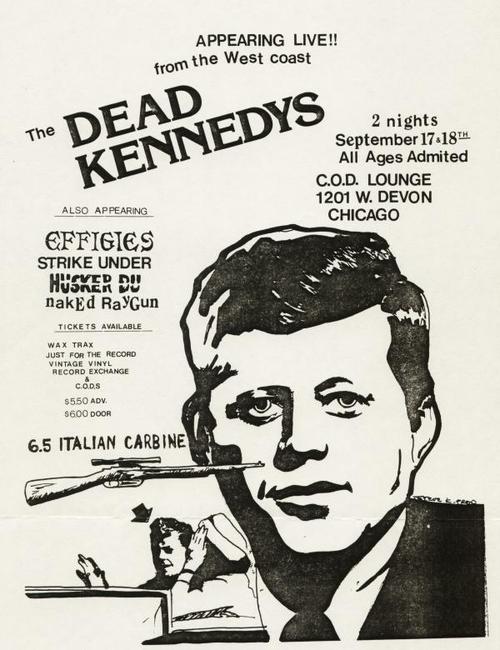
Here is some Chicago punk history for you. Steve Bjorklund formed Strike Under in 1980 after the end of his first band, which was apparently a garagey, protopunk sort of group called the Rabbits. Strike Under consisted of Steve, his brother Chris (later of the Effigies), Pierre Kedzy (later of Naked Raygun), and Bob Furem, who later played in Da. Their first show was at Northeastern University, and through 1980 and 1981 they played the usual places such as Tut's and Oz.
Their only proper release was 1981's Immediate Action 12" EP, which is notable for being the first record from Wax Trax, back before it was a powerhouse of industrial music. The songs are melodic without sounding too polished. Is this the so-called 'Chicago Sound?' I dunno, but it's pretty clear to me that the songs 'Sunday Night Disorientation' and 'Elephant's Graveyard' make this EP worth having. Long out of print. You can read a great Coolest Retard review of this record, as well as a review of Da's Dark Rooms 7'' and a Strike Under interview, in the Dementlieu Punk Archive.
a pretty stacked night, this one
Strike Under also had two songs on the 1980 Busted at Oz live comp, which I will probably post eventually. Also, in 2010 there was a sort-of reunion of Strike Under, as part of the Busted at Oz reunion shows. Vic Bondi from Articles of Faith was one of the dudes in the 'Strike Under covers band,' as it was called. The performance was taped and can be acquired at this wonderful blog.
After Strike Under broke up, Steve kept at it, forming Breaking Circus in 1983. Their first gig was at the Cubby Bear, back when they would regularly book punk bands. They released The Very Long Fuse EP in 1985, and Steve Albini designed the cover art. It's very much an '80s record, sort of like post-punk plus folk plus drum machine (later, when the band relocated to Minneapolis, the drummer's spot was taken by Todd Trainer, who you probably know as the drummer for Albini's Shellac). Famously includes '(Knife in the) Marathon,' which is one of the catchiest songs ever. I defy you not to get it stuck in your head.
For the hell of it, I also put up a single that Mr. Bjorklund did in the late '80s, after the demise of Breaking Circus. It was put out under the band's name, but appears to be only Steve and a drum machine. The A-side is a very bare take on Naked Raygun's 'Home of the Brave,' and the other is a UK Subs song, again quite transformed by Bjorklund's arrangement. I'm pretty certain it's out of print.
This is not a top ten. I'm not ranking them or anything. I'm really pretty slow about getting hipped to new music every year, but here are a dozen or so that I have been digging throughout 2011. Buy all of these.
1. CAVE - Neverendless
More tight motorik grooves from Chicago's best krautrock enthusiasts. The first and last songs are my favorite ones on here. I'll defer to the wonderful review in the Chicago Reader from a couple months back, since I can't write a better one.
This album just feels good to listen to (especially in the summer, or when you're trying to pretend it's warm). I first saw Peaking Lights at Bitchpork a couple of summers ago, and have been digging them ever since. This is probably the album from 2011 I have played the most. Repetitive, bouncy dub basslines with psyched-out, homemade synths and pretty words. If that doesn't sound like much then you don't know what you're missing.
I'm not gonna pretend to be some connoisseur of rap music, but this mixtape is pretty sick. You've got rhythmic extraordinaire Zach Hill making fucked up beats for MC Ride to spit all over. The ridiculousness is turned all the way up for the whole set, and it is pretty damn intense. Critics are all saying this is hardcore punk pretending to be rap, which I guess isn't too inaccurate. If Black Flag samples are cool to you, or if you enjoy lyrics about being fucked up on DMT and listening to Sonic Youth, you should probably get this. I put up my own link but it appears to be free from Death Grips' website. Here's a video:
Holy christ, what an album this is. Like the CAVE album above, the song titles are pretty much indecipherable, and the emphasis is on the extremely tight instrumentation. Besides liking some bands such as Tortoise, I have no idea what the term 'post-rock' is supposed to mean, but it has apparently been applied to the Psychic Paramount. Regardless of what you take away from that description, know that these dudes most certainly know how to rock. II is noisy, psychedelic, incredibly rhythmic (the songs were composed on drums), and easily one of my favorite albums of 2011.
Pink Reason songs often sound like they're recorded on the comedown from a heroin binge (see the excellent Winona 7" for prime examples). And that's cool. But this year Kevin De Broux (sometime member of Psychedelic Horseshit) put out something bigger. Shit in the Garden definitely sounds more produced than most of Pink Reason's previous work, but not in a bad way. Just sounds like Mr. De Broux spent more time putting this one together. There's electronic glitch-beats, soaring pop anthems, swirling psych-punk guitar, banjo, and equal doses of bitter and sweet throughout. This album reminded me of some of Egor Letov's early '90s stuff (Egor who, you ask? I'll post later), which makes sense since Kevin lived in Siberia for a couple of years in the '90s (and is compiling info for a book on Soviet-era Russian punk while touring Eastern Europe). Listen, this record is really good.
If I tried to write too much about the Spits, it would come off as unnecessary intellectualizing. For those who don't know, the Spits are a punk band. They play punk music and they play it well. If you dig the Ramones and Misfits, then there's nothing not to like here. Seriously, just look at the cover art.
7. Matana Roberts - Coin Coin, Chapter One: Gens de Couleur Libres
What we have here is a brilliant (free-?) jazz concept album about an 18th-century slave who manages to get herself freed, and all of the agonizing shit that happens prior to that. It ends on a hopeful note but I won't spoil anything, since I can't tell it as good as Matana. The playing is good, and runs the gamut from bouncy swing 1920s jazz to cosmic free jazz with prepared guitar, but the thing everyone will really like about this record is Roberts' fierce storytelling vocals. This record is punk as fuck, and my stupid review can't possibly do it justice.
He's still good. Overall, I'm not really familiar with Tom Waits' recent stuff, but my dad burned me a a copy of this CD so I've been digging it. It's a mix of Beefheartian blues free-kouts, soulful laments, and rocking the fuck out. There's even an aside of 'Auld Lang Syne,' just in time for your depressing plod into the New Year. My favorite song on here is almost definitely the Iraqistan-vet dirge 'Hell Broke Luce.' My god, it's Tom Waits, why are you still reading this? Just get it.
This, I believe, is Taiwanese-Canadian Alex Zhang Hungtai's first proper record as Dirty Beaches, although he did release some instrumental stuff under the name. Badlands is a minimal, lo-fi, washed-out perversion of 1950s rockabilly. Songs of isolation, empty highways, and dirt, coming out sounding like Alan Vega singing for Les Rallizes Dénudés (the song 'A Hundred Highways' is, in fact, just like Rallizes' 'Night of the Assassins'). What's that, a Suicide reference AND Rallizes? It must be good...
Basically everyone ever thinks this record is amazing. With that kind of hype, one must wonder: is it actually good? As far as I can tell, it is very good. Iceage sound a bit like Wire playing hardcore, or like if Jay Reatard was from Denmark instead of Memphis. I was so pissed to have missed their Chicago date this past summer (Raw Nerve was opening, I believe), because they're supposed to be even better live. In any case this sub-25 minute post-punk blast is something you probably have already, but check it out if you haven't. New Brigade has been confusingly in and out of print all year (selling like fucking hotcakes, man), so I just posted an insound link for those of you cool enough to buy it.
Cülo never fails to impress, and this is probably my favorite record they've put out so far (that new split with Tenement is pretty tight, though). I guess 'Brain Cavity' and the titular track are my favorites, but it's sort of pointless to pick because it's a short record and all the songs are great. It has been many a morning these past few months that Toxic Vision was the thing that got me out of bed to bike to class. Some of the best hardcore Chicagoland has to offer.
Broken Water are a spaciously-noisy post-punk band from somewhere in the Pacific Northwest (Olympia? Portland? I forget), and this EP was their follow-up to 2010's Whet, which was also great. Peripheral Star is a winning combination of pop brilliance and punk aggression with male-female vocals and Sonic Youth sheets of noise. 'Stop Means Stop' is straight-up riot grrrl. The last song is sung in Japanese, so that's pretty cool.
Hardcore that's not too (read: unlistenably)hardcore and punk that is plenty punk. All the songs except for the title track are less than one minute, and cover such topics as hating work, playing D&D, and being at house shows (or so I think; the lyrics are rather unintelligible). The music itself is just perfectly executed, and the bass throws mud and shit all over the place. I regularly listen to this on repeat; if you play it 6 times it makes for a great LP.
Tyvek sounding like Tyvek in three quick garagey punk bursts. As usual, the fidelity is fucked and the instruments are trashed. This was a 7" from their tour of Europe or something. In any case it burns as well as any other Tyvek release.
Here are a couple of fantastic singles by the Bard of Salford, Greater Manchester's punk-poet himself, John Cooper Clarke. He's probably best known (if he's known at all) for his a capella rapid-spat poems, but on these records he's backed by a group which called themselves the Invisible Girls. Clarke's lyrics are great as one might expect, and the backing band doesn't sound tacked on, instead straddling the border between krautrock-influenced post-punk and good old '77 rabble, managing to find themselves in disco territory without sucking, on the second record's A-side.
In the 1980s Clarke spent a lot of time being addicted to heroin with the famous Nico, so maybe that will pique your interest. He's also in the 1982 film Urgh! A Music War, which is worth finding for his performance as well as those of the rest of the underground bands in it.
Mr. Clarke performs to this day, so you should go see him if you get the chance.
I haven't got much to say about this one. What you've got here is some pretty basic, solid good UK punk. Songs about war and The Man and whatever ("Dead Hero," "Fire Another Round," "Suspicion," you get the gist). This is a quick one, so just download it already.
Here's a quick post of early-eighties Chicago punk for ya. This is a really good 7" from a band who are admittedly little more than a footnote in the scene, itself often relegated as a footnote of the early punk sphere. DV8 consisted of vox/guitarist Lorin Klugman, drummer Eric Spicer, and Bob Hanchett on bass. Spicer provides the obligatory Naked Raygun connexion; he played with them from '84 to '92, playing on the records after All Rise, released in 1986. This is the band's only release, and they broke up in 1982.
But on to the actual songs. The A-side is the best Clash song the Clash never wrote, and the B-side is just as good. This is a single I find myself returning to often, because it's a fucking good record. If you've got $300 to blow, it shows up on eBay for about that amount every once in a while. Needless to say, it's long out of print.